
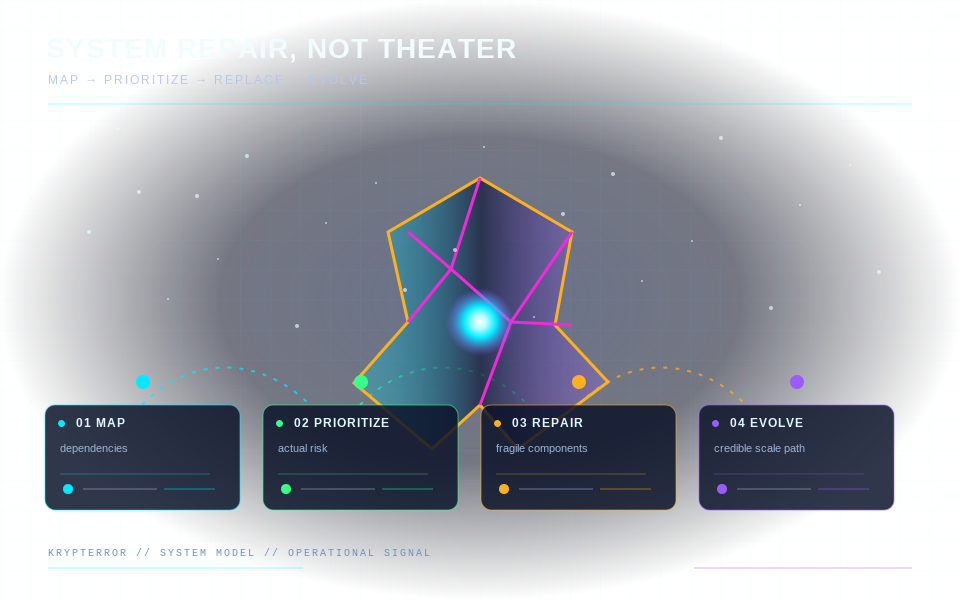
We address technical debt according to the risk it creates for the product. We establish system ownership, document behavior, identify fragile dependencies and make sensitive components safer to change.
No Speculative Rebuilding
We preserve working components and change those that are unsafe or impractical to maintain. A repair should not become a rewrite without a clear justification.
The Order of Work
We prioritize failure risks that could affect customers next month over code improvements that might help developers next quarter. We establish that order by reviewing the code, infrastructure and dependencies, then assessing how a process operates. Code-quality scores can inform the review, but they do not determine business risk.
What the First Pass Produces
The first pass produces a prioritized risk list. Each item includes the likely impact of failure and the smallest change that addresses it. We document the constraints shaping that change, such as a contract, launch date or budget. The plan also identifies what we recommend leaving unchanged and explains why, so the scope does not expand into an unnecessary rewrite.
The Parts Nobody Dares Change
Fast-growing systems often contain untested modules, fragile deployment procedures or components understood by only one person. Before changing them, we add characterization tests to document current behavior. We then make small, reviewable changes with a rollback path, reducing the risk that maintenance causes an outage.
Rewrites, When One Is the Answer
A rewrite may be justified, but it carries substantial cost and migration risk. We review the codebase before recommending one and document the rationale, estimated cost, migration path and period of parallel operation. That gives you a basis for comparing replacement with smaller repairs.
Where This Overlaps
The system inventory also informs security hardening and identifies dependencies worth replacing with software you control. Options are covered in software you can stop renting, while the security assessment uses the same risks to set its priorities.
What gets fixed first?
Failure risks that could affect customers next month come before code improvements that might help developers next quarter. We establish that order by reviewing the code, infrastructure and dependencies, then assessing how a process operates. Code-quality scores can inform the review, but they do not set business risk.
Does this end in a rewrite?
Not by default. We preserve working components and change only what is unsafe or impractical to maintain. A rewrite is documented with its rationale, estimated cost, migration path and period of parallel operation when one is genuinely the answer, so you can compare it with smaller repairs.
How are risks ranked?
By the likely impact of failure and the smallest change that addresses it, with the constraints shaping that change — a contract, a launch date, a budget — written down. The plan also states what we recommend leaving unchanged and why, so the scope does not expand into an unnecessary rebuild.
What about the code nobody dares change?
Characterization tests document current behavior before anything moves, then the changes are small, reviewable and reversible. That order reduces the risk that maintenance itself causes the outage, which is the usual failure mode of untested modules and fragile deployment procedures.
Tell us which manual process you want to improve. We will assess the requirements and scope an automation project.
Contact us today