
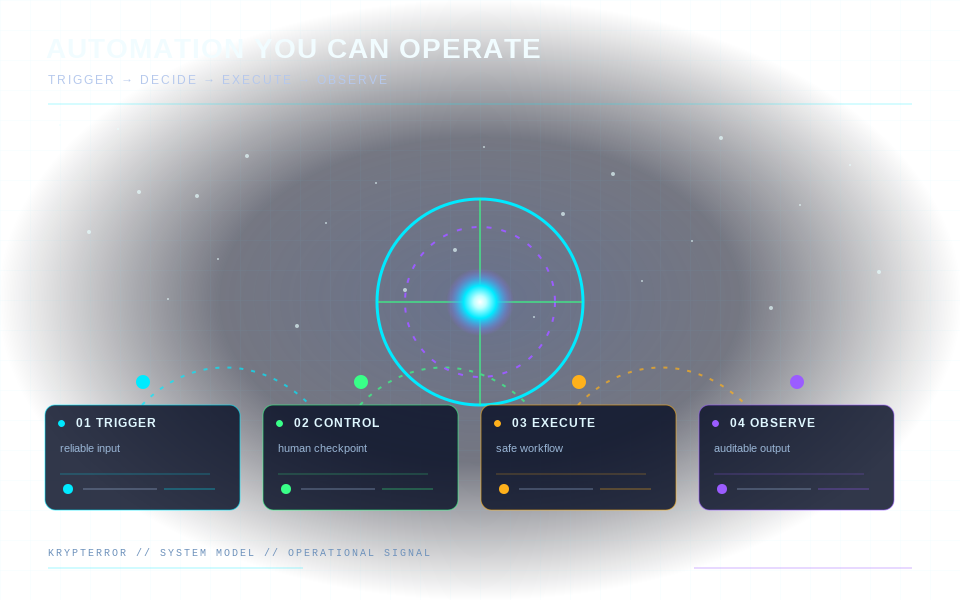
Work That Can Be Automated
Moving data between systems, chasing approvals, preparing recurring reports, and reconciling payments manually take time your team could spend on other work.
For illustration, four people each spending six hours a week on a repeatable task account for 1,248 staff hours over 52 weeks. Multiply those hours by your fully loaded hourly labor cost to estimate the current effort’s annual cost. Then compare the portion automation could realistically remove with the cost of building and operating the system.
As your business grows, these tasks demand more staff time. Another software subscription may increase costs while still leaving your team to move information between tools by hand.
Krypterro Technologies builds the applications that handle this work. We design each system around your processes, including the exceptions and decisions that need a person. Your team gets working software on infrastructure you control, with the documentation to operate and maintain it.
A One-Time Build Instead of Another Subscription
Invest in a system your business owns rather than another workflow tied to a vendor's pricing and product roadmap. We select and customize open-source foundations, connect them to your existing systems, and deploy the finished application under your accounts.
You pay once for the agreed build scope. We do not charge ongoing software licensing fees, per-seat fees, or per-record fees. Hosting, maintenance, security updates, and backups remain real operating costs; we assess them alongside the subscription costs a replacement would remove. Ongoing support is available under a separate agreement, not a condition of using your software.
Where replacement does not make financial or operational sense, we say so. The assessment establishes which processes are worth automating and which systems are worth replacing before you commit to a build.
What Ownership Gives Your Business
- Control over the system. You receive the custom source code, documentation, and administrative access. You decide where it runs, who maintains it, and what changes next.
- Software that fits your processes. Workflows, approval rules, and integrations follow your operations rather than the limits of a vendor's product.
- A defined investment. We agree on the build scope and fee in writing. Any later scope change requires your approval with its cost stated.
- Room to adapt. Open-source foundations and documented code let your team maintain and extend the system as requirements change.
- Control over data and privacy. You determine where records are stored and who can access them. Controls can support your compliance obligations; owning the system does not itself establish compliance.
- Protection for proprietary business logic. Your custom processes and algorithms remain in code you own. Open-source components retain their respective licenses.
- Security under your control. Access permissions, network boundaries, and monitoring can be designed around your risk profile and internal standards.
What We Build
We deliver the software that runs the process; we do not take over your daily operations. Each application uses open-source components, runs on infrastructure you control, and is handed over to your team. Typical builds include:
- Order, invoice, and fulfillment applications that connect systems without a suitable existing integration.
- Customer onboarding applications that create account records, assign setup tasks, and track missing information before service begins.
- Inventory applications that check stock levels, flag shortages, and prepare replenishment requests for approval.
- Document-processing applications that extract information from PDFs, forms, and attachments, match it to records, and file it.
- Approval applications that route requests and escalate stalled decisions to the right person.
- Reporting applications that assemble recurring reports and deliver them through the channels your team uses.
- Reconciliation applications that compare payment records, accounting systems, and internal ledgers.
- Internal tools that replace work spread across browser tabs, spreadsheets, and a shared inbox.
Built for Daily Operations
An automated process needs to be dependable when a system is unavailable, a record is incomplete, or a decision requires review. We build in the controls your team needs to manage those situations:
- Error handling, retries, and safeguards against duplicate orders or payments.
- Audit trails that record actions, inputs, and the rules applied.
- Logs, metrics, and alerts that direct failures to an accountable operator.
- Human review at the steps that require judgment or approval.
- Credentials stored outside the code, with permissions limited to the actions required.
- Backups and a documented, tested recovery path.
How a Build Runs
- We review the process as it runs today, including exceptions, transaction volume, current costs, and the systems involved.
- You receive a written design defining the workflow, integrations, data boundaries, failure handling, human decision points, and scope exclusions.
- We agree on a fixed build fee before implementation begins. You approve any subsequent scope changes and their costs.
- We build and deploy the application on infrastructure you control. Where migration is needed, we plan data export, verification, and rollback before the transition.
- We hand over the source code, runbook, credentials, and diagrams, and walk through the system with its future operator.
- You choose whether to arrange ongoing support under a separate agreement.
Most engagements begin with a paid assessment, credited against the build if you proceed. It gives you a defined scope and a cost basis for the decision.
Where AI Belongs, and Where It Does Not
Defined rules are handled by deterministic code that can be tested and audited. AI agents are used where interpretation adds value, such as classifying ambiguous requests, extracting information from unstructured documents, or preparing drafts for human review.
Each agent runs under its own Linux user, with a custom Python toolset, permitted actions, a cost ceiling, logging, and a human override. See AI agents: integration and management for delivery details.
What does an automation build cost?
It is priced as a one-time build: we agree the scope and the fee in writing before implementation begins. There are no ongoing software licensing, per-seat or per-record fees. Hosting, maintenance, security updates and backups remain real operating costs, and most engagements begin with a paid assessment credited against the build.
Who operates the system after handover?
Your team does, using the source code, runbook, credentials and diagrams handed over at the end of the build; we walk the system through with its future operator. Ongoing support is available under a separate agreement if you want it, and it is not a condition of using the software.
What happens to the tools we keep?
They are integrated with the new application rather than replaced by default. Where replacement does not make financial or operational sense we say so, because the assessment establishes which processes are worth automating and which systems are worth replacing before you commit to a build.
Can a manual approval step stay?
Yes. Human review remains at the steps that require judgment or approval, with escalation when a decision stalls. Defined rules are handled by deterministic code, and AI is used only where interpretation adds value, with a person able to verify the result.
Discuss a Process You Want to Improve
Tell us where manual work is slowing your team down or where a SaaS platform is limiting your operations. We can assess the workflow, identify a practical starting point, and define what an owned system would need to deliver.
Related Answers
What does business process automation cost? · What does owning your automation mean? · Owning versus renting a tool
Tell us which manual process you want to improve. We will assess the requirements and scope an automation project.
Contact us today