
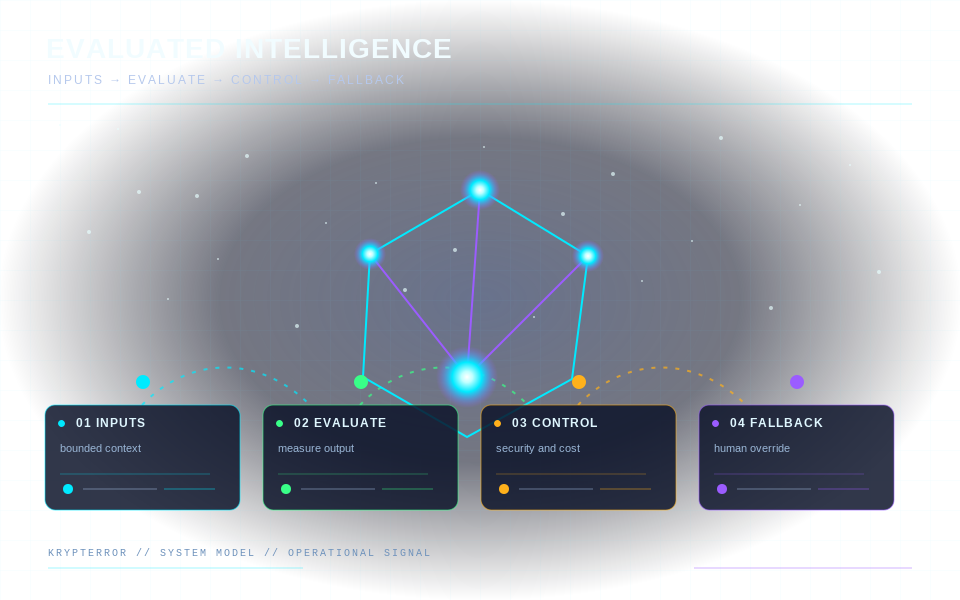
An Agent Performs a Narrowly Defined Task
A useful agent performs a defined task within an existing business process. It might classify incoming messages, extract fields from a supplier PDF, draft a reply for human approval, prioritize tickets or assemble a weekly summary from six systems. Its scope determines which actions it can take and where a person remains responsible.
Tasks governed by defined rules should use deterministic code. It is cheaper, faster to test and easier to audit. An agent is appropriate where a step requires interpretation of ambiguous input, unstructured language or uncertain conditions, and a person can still verify the result.
What We Build Them With
Hermes Agent is an open-source agent runtime in the same broad category as Claude Code or Codex. We deploy it on a Linux machine you control, without a mandatory vendor cloud account for the runtime. It supports different model providers and stores configuration, memory, skills and session records as files on that machine.
Two deployment decisions limit the access available to each agent: a separate Linux user and a narrowly scoped toolset.
One Agent, One Linux User
Every agent we deploy runs under its own Linux user. Separate accounts establish an operating-system access boundary, supported by the following controls:
- Its configuration, memory, session history, credentials and tool code live in its own home directory, with permissions restricting access by other agents.
- It can read and write only what its user account permits, limiting the effect of an unsafe instruction on other agents and the server.
- Two agents working on different parts of the business have separate files, keys and sessions protected by account permissions.
- Your operators can review activity, stop the process, disable the account or remove it directly, without requesting access from a platform vendor.
- If you already operate the host, the agent can use the monitoring, backups and access policies established there.
Sharing one account, one API key and unrestricted filesystem access makes activity harder to attribute. Separate identities help operators determine which agent performed an action and which resources it could access.
A Custom Python Toolkit for One Job
Each agent gets a purpose-built Python toolset for the systems it is allowed to touch: create the invoice, look up the order, post to the channel, fetch the document, update the record. Every tool takes a narrow argument list, has defined failure behavior and writes a log entry for each call.
When a call fails, that entry names the attempted action and the failure. Reviewing a set of narrow tools is more manageable than auditing a general-purpose account with broad access across your systems.
Integration Is Most of the Work
Production integration establishes which systems an agent can reach, which credentials and permissions it uses, whose data it processes and how failures are handled. The implementation includes the following controls:
- We authenticate access to your CRM, helpdesk, inbox, database or internal API using a token scoped to that one agent, rather than a shared master credential.
- We define an allowlist of permitted actions and require approval for irreversible actions.
- We implement idempotency and retry handling to prevent repeated calls from sending duplicate emails or creating duplicate records.
- We log relevant inputs, actions, tool calls, outputs, and model versions, with agreed redaction, access controls, and retention periods.
- We record the model, prompt and tool version behind each result so changes in behavior can be investigated.
Management Is the Other Half
An agent needs ongoing evaluation, cost monitoring and version records after launch. Without those controls, a team can miss declining output quality or rising usage. Management capabilities are part of the build we hand over:
- The inventory identifies every agent, its Linux user, tools, accessible systems and responsible person.
- Configuration, tools, prompts and skills are version-controlled so changes can be reviewed, reversed and used to rebuild the agent on another host.
- A test set drawn from real inputs runs before every change, checking that prompt edits do not break the twenty most common cases before deployment.
- Each agent has a daily cost ceiling, a deliberately selected model tier and alerts for loops or excessive retrieval.
- Monitoring tracks failure and refusal rates, latency, fallback frequency and changes in the requests an agent receives.
- The runbook documents how to stop an agent, revert an action and return its queue to a person the same day.
- Rollout is staged, model versions are pinned, and a retirement procedure covers agents that no longer provide sufficient value.
Model-Agnostic, on Purpose
We have no model-vendor partnerships and receive no model-vendor commissions. Each agent uses a configurable model, reducing dependence on a single provider. If pricing, model availability or capacity changes, we can evaluate another model and update the configuration without rebuilding the surrounding process.
We select models per agent rather than imposing one choice across the company. There are three deployment options:
- A frontier model through an API, in the Claude, GPT or Gemini class, provides advanced reasoning without model-serving hardware to operate. It carries per-token charges, and data reaches the provider under its terms. It can suit low-volume steps requiring substantial judgment.
- An inexpensive open-weight model through a hosted inference provider can reduce per-token costs while providing suitable quality for classification, extraction and drafting. It remains a hosted service, so the provider's data-handling terms still apply.
- A fully self-hosted open-weight model, using Qwen, Llama, Mistral or DeepSeek class weights, runs on your hardware or in your cloud account. Model processing stays within that boundary, and hardware and operating costs replace per-token charges. Your team takes responsibility for operation and evaluates capability limits against the task.
This allows model choice to reflect the work and its data requirements:
- An agent performing ten thousand classifications a month may need a different model from one making a dozen difficult judgment calls a day. Selecting per agent helps control the monthly bill.
- Public web copy can go to a hosted model while privileged documents stay behind your boundary. We write down which is which.
- A lower-cost model can handle routine work and escalate to a frontier model when confidence drops. The routing can be reversed where latency matters more than depth.
- Provider selection remains in configuration, preserving the tools, audit trail and surrounding process when a different model is selected.
We run your evaluation set across two or three candidate models and compare accuracy with cost before pinning a choice. If a lower-cost model meets the requirements, we recommend it. If the task needs a frontier model, we explain the difference and estimate monthly cost at your expected volume.
Model selection is versioned alongside each agent's prompts and tools, so your team can identify which model produced an output months later.
Why This Matters
- True ownership: You retain the custom tool code, evaluation set, runbook, and deployment configuration. The runtime remains under its open-source license. Continued use of hosted models depends on provider availability, terms, and charges.
- Containment: Separate Linux users, least-privilege credentials, and narrowly scoped tools limit the resources an incident can reach. The protection depends on the permissions and connected systems involved.
- Attribution: Every action, credential and model version traces to a single agent and a person responsible for it.
- Predictable cost: A fixed build fee and a stated daily ceiling replace per-seat pricing and unbudgeted token spend.
- Model independence: Configurable providers reduce switching work. A replacement model is evaluated for tool compatibility, output quality, cost, and data-handling requirements before deployment.
- Data boundary: You decide which documents leave your network and which never do, and we write the decision down.
- Operational fit: The agent runs on the host, backups, monitoring and access policies you already operate.
What We Will Not Ship
- An agent with production write access and no audit trail.
- Agents sharing a Linux user, credentials or unrestricted filesystem access.
- An agent as the only path through a critical process, with no manual fallback.
- An agent without an estimate of monthly operating cost.
- An agent without behavior evaluation and a pinned model version.
- An AI strategy presentation in place of a working system.
How an Engagement Runs
A short paid assessment establishes whether the step needs an agent at all. Often it does not, and a deterministic script is the cheaper build. When it is an agent, scope is fixed in writing: what it reads, what it may do, what it must escalate, what it costs to run, and how it is switched off.
We build, harden, document and hand over the system. You control the Linux user, tool code, evaluation set and runbook, and can change or replace the model without our permission. The build has a fixed fee and written scope. Ongoing support is optional. See business process automation for the process side, and open-source business systems for the platforms an agent works against.
When is an agent the wrong answer?
When the step is governed by defined rules. Deterministic code is cheaper, faster to test and easier to audit, and the paid assessment establishes whether the step needs an agent at all. Often it does not, and a script is the better build.
How is each agent isolated?
Each agent runs as its own Linux user with its own home directory, credentials, memory, session records and tool code, so permissions restrict what it and any other agent can reach. Your operators can review its activity, stop the process, disable the account or remove it without asking a vendor.
Which model do we use, and who chooses?
You do, per agent, from three options: a frontier model by API, an inexpensive open-weight model through hosted inference, or a fully self-hosted open-weight model on your own hardware. We run your evaluation set across two or three candidates and compare accuracy with cost before pinning one.
What happens when an agent misbehaves?
It can be stopped, its last action reverted and its queue returned to a person the same day, following the runbook handed over with the build. Every action, credential and model version traces back to a single agent and one responsible person.
Related Answers
Tell us which manual process you want to improve. We will assess the requirements and scope an automation project.
Contact us today